
Sudoku X Rules: How Diagonal Sudoku Changes the Game
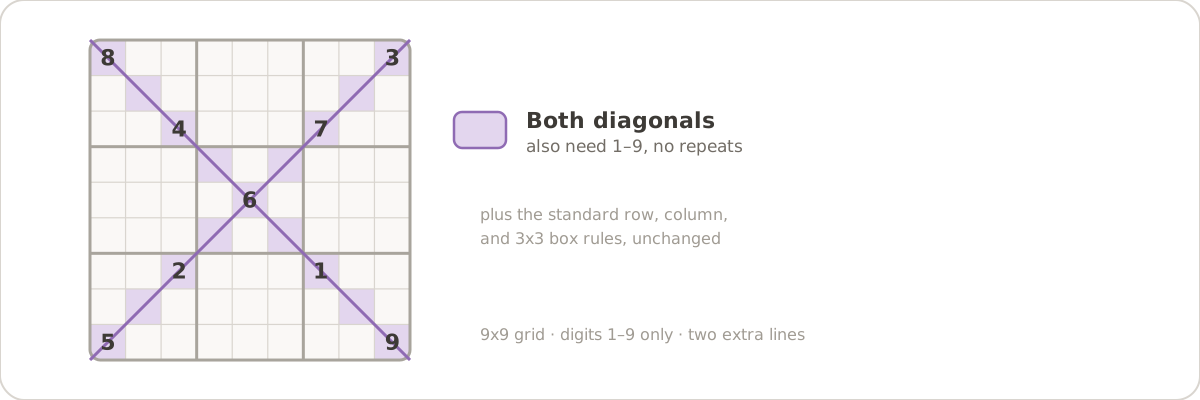
Sudoku X — also called Diagonal Sudoku — starts from the exact same rules as Classic Sudoku and adds exactly one more constraint: the two lines running corner to corner. That single addition changes how you scan a puzzle without changing anything else about how Sudoku works. This guide covers the full rule set, walks through a worked example on the diagonals, and answers the questions solvers ask most when they try it for the first time.
The grid
Sudoku X uses the identical 9x9 grid as Classic Sudoku — 81 cells split into nine 3x3 boxes. The only visual difference is the two diagonal lines running through the board, which our version tints so you can spot them at a glance. Everything else about the layout, the clues, and the way you interact with the grid is unchanged from Classic.
The rules: standard, plus one
Every Classic Sudoku rule still applies in full:
- • Each row contains 1–9 exactly once — no repeats.
- • Each column contains 1–9 exactly once — no repeats.
- • Each 3x3 box contains 1–9 exactly once — no repeats.
Sudoku X adds a fourth requirement on top of those three:
- • Each main diagonal — top-left to bottom-right, and top-right to bottom-left — also contains 1–9 exactly once, no repeats.
All four rules hold simultaneously. A digit that's perfectly legal for its row, column, and box can still be wrong if it repeats a digit already sitting elsewhere on the same diagonal — that's the entire extra layer Sudoku X adds. The two diagonals cover 17 cells total (9 + 9, minus the center cell they share), so most of the grid is still governed only by the original three rules.
A worked example
Look at the highlighted X in the image above. Nine clue cells sit on the two diagonals: reading the top-left-to-bottom-right diagonal gives 8, 4, 6, 1, 9, and the top-right-to-bottom-left diagonal gives 3, 7, 6, 2, 5 (the 6 in the center is shared by both). Between them, every digit from 1 to 9 already appears exactly once across the X — which means, in a fully solved grid, no other cell on either diagonal could ever legally hold any of those nine digits again.
That's the practical value of the diagonal rule: once you've located every digit already placed somewhere on a diagonal, you've effectively pre-solved that entire line, the same way a nearly-full row tells you what's left to place. It's an extra check to run alongside your usual row, column, and box scanning — not a replacement for it. Our solving techniques guide covers the underlying scanning and elimination methods that still do most of the work in Sudoku X.
Why Sudoku X plays differently
The diagonal rule rewards a habit most Classic Sudoku players don't build by default: glancing along both diagonals whenever you place or consider a digit near the center of the board. A move that looks safe from the row/column/box perspective can still conflict with a digit two boxes away on the same diagonal, so cells near the diagonals often resolve faster than you'd expect once you start checking that fourth line out of habit. It's the same underlying logic as Classic Sudoku, just with one more constraint to fold into your scanning routine.
Difficulty levels
Sudoku X ships with slightly more starting clues than Classic Sudoku at each difficulty label, to offset the extra deduction the diagonal rule demands:
Easy
43 of 81 clues
Good for learning the diagonal rule
Medium
35 of 81 clues
A balanced challenge
Hard
29 of 81 clues
Puts your diagonal reasoning to the test
Common rule mix-ups
- • Only checking one diagonal — both diagonals are independent rules; satisfying one doesn't say anything about the other.
- • Forgetting cells off the diagonal are unaffected — the diagonal rule only constrains the 17 cells that sit on an X line; every other cell still follows only the row, column, and box rules.
- • Assuming the center cell has special rules — it doesn't get a different rule, it just belongs to two groups (both diagonals) at once, the same way a normal cell belongs to one row, one column, and one box.
- • Mixing up Sudoku X with Killer Sudoku — Sudoku X adds two more no-repeat lines; it doesn't add any sums or cages, so it's still pure placement logic like Classic.
Ready to try the diagonal rule for yourself? Start with Easy to get a feel for the X.
Play Sudoku XFrequently asked questions
What are the rules of Sudoku X?
Sudoku X uses the same 9x9 grid and the same row, column, and 3x3 box rules as Classic Sudoku, plus one addition: both main diagonals (top-left to bottom-right, and top-right to bottom-left) must also contain the digits 1 through 9 exactly once, with no repeats.
Which cells count as the diagonals in Sudoku X?
The two main diagonals are the cells running from the top-left corner to the bottom-right corner, and from the top-right corner to the bottom-left corner. Together they cover 17 of the grid's 81 cells, since the center cell belongs to both diagonals at once.
Is Sudoku X harder than Classic Sudoku?
Generally yes, at a matched clue count, because the two diagonal constraints add extra deductions to track alongside the usual row, column, and box checks. To keep puzzles fair, Sudoku X typically ships with a few more starting clues than Classic Sudoku at the same difficulty label.
Does the center cell follow special rules in Sudoku X?
The center cell isn't governed by a different rule, but it is special in one sense: it's the one cell shared by both diagonals, so whatever digit lands there has to be consistent with the no-repeat requirement of both diagonal lines simultaneously, not just one.
How many clues does a Sudoku X puzzle start with?
Easy starts with 43 of the 81 cells filled in, Medium with 35, and Hard with 29 — a bit more generous than Classic Sudoku's clue counts at each difficulty, to offset the extra challenge of the diagonal rule.
Can a digit repeat on a diagonal if it's in a different row and column?
No. A digit repeating anywhere on the same diagonal is a violation even if the two cells belong to entirely different rows, columns, and boxes. The diagonal is its own independent group, just like a row, column, or box.
Keep reading
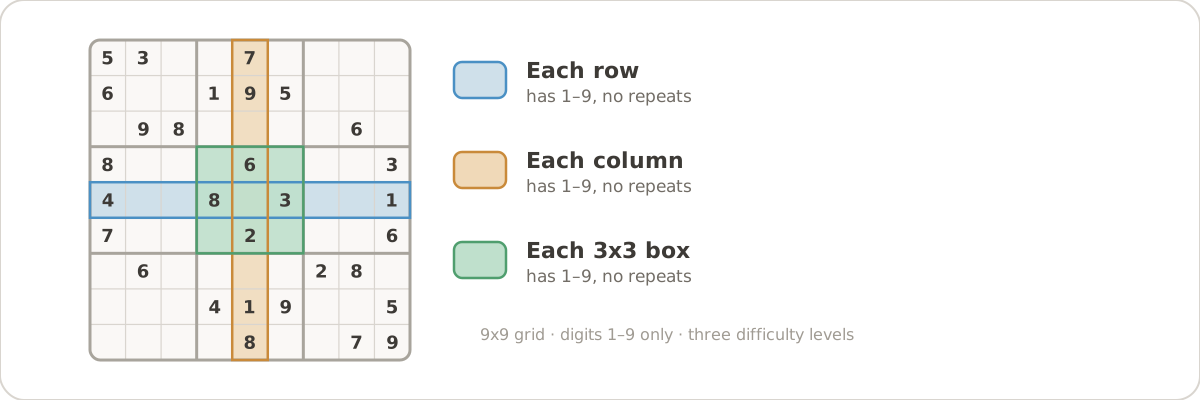
Classic Sudoku Rules: How to Play 9x9 Sudoku Step by Step
The base rules Sudoku X builds on, with a worked example and difficulty levels.
Read more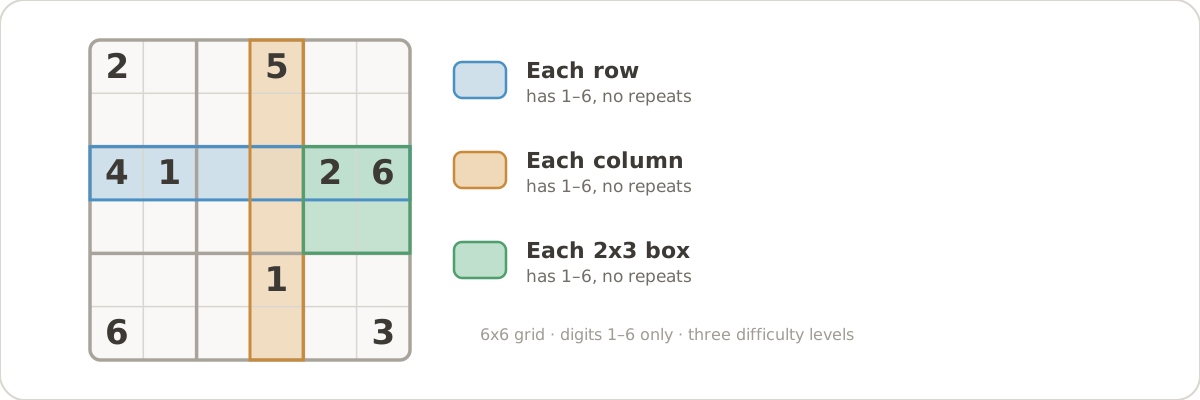
Mini Sudoku Rules: The Complete 6x6 Beginner's Guide
Every rule of 6x6 Mini Sudoku explained with board diagrams and a worked example.
Read more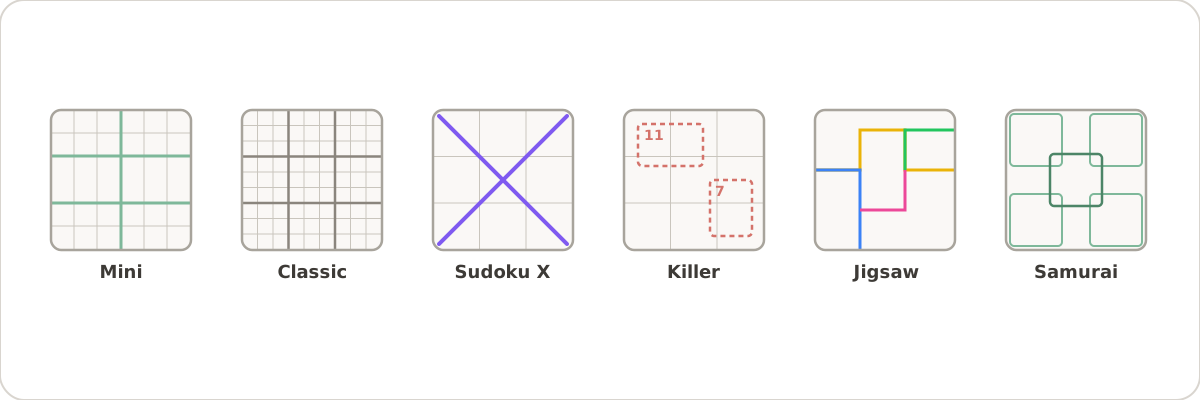
Mini vs Classic vs Killer vs Jigsaw vs Samurai Sudoku: Which Should You Play?
A side-by-side comparison of every Sudoku variant we offer.
Read more