
Sudoku Solving Techniques: A Complete Guide From Beginner to Advanced
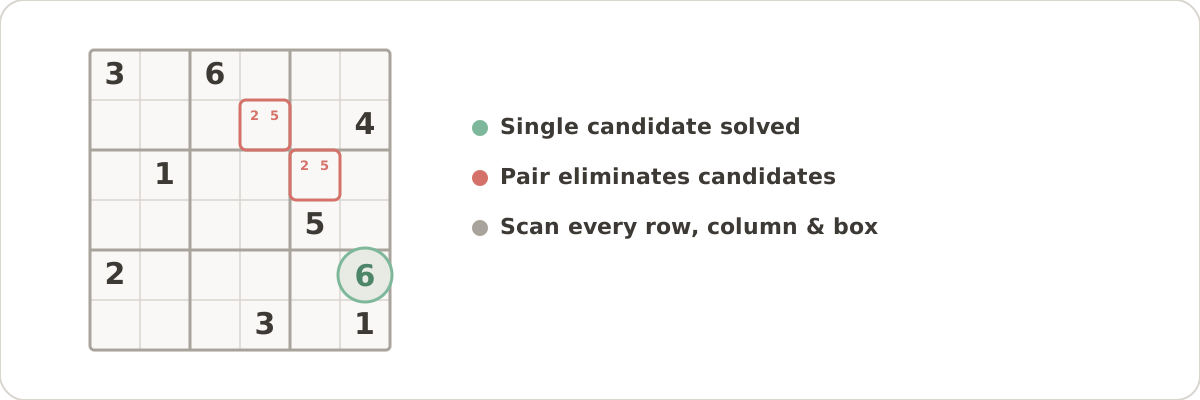
Every Sudoku puzzle, no matter the grid size, is solved with logic alone — there's never any need to guess. The techniques below apply whether you're working on a 6x6 Mini Sudoku, a 9x9 Classic Sudoku, or one of our trickier variants. They're ordered by how often you'll actually need them: the first few solve the vast majority of puzzles on their own, and the later ones — triples, box/line reduction, X-Wing, Swordfish, and Y-Wing — only come into play on the puzzles that resist everything simpler.
Jump to a technique
1. Scanning (the foundation of every solve)
Scanning means picking a number, then checking every row, column, and box to see where it can and can't go. If a row already contains a 4, no other cell in that row can be a 4. The same rule applies to columns and to each box. Cross off the impossible cells in your head (or with pencil marks) and you'll often find a cell where only one number fits.
For example: say you're hunting for where 5 can go in a particular box. Two other cells in that box already share a row with a 5 elsewhere on the grid, and a third empty cell shares a column with another 5. That rules out three of the box's empty cells in one pass, often leaving just a single candidate cell for that 5.
On a 6x6 grid this alone will solve Easy and most Medium puzzles. On 9x9 grids, scanning gets you started but you'll usually need the next few techniques to finish.
2. Naked Singles
A "naked single" is a cell that has only one possible candidate left once you've eliminated every number already used in its row, column, and box. If you're keeping pencil marks (small candidate numbers in each cell), a naked single is any cell with just one pencil mark remaining — that number can be filled in immediately, no further checking required.
4. Naked Pairs
A naked pair is two cells in the same row, column, or box that share the exact same two candidates and nothing else. For example, if two cells in a row both show only "2, 7" as pencil marks, one of them must be 2 and the other 7 — you don't yet know which, but you know for certain that no other cell in that row can be a 2 or a 7. Removing those two candidates from the rest of the row often reveals a naked or hidden single elsewhere.
6. Pointing Pairs and Box/Line Reduction
These two work across a box and a line, just in opposite directions. A pointing pair (or pointing triple) starts inside a box: if a candidate number only appears in two or three cells of a box, and those cells all sit in the same row or column, that number can be eliminated from the rest of that row or column outside the box — the box is "pointing" the candidate out along the line.
Box/line reduction runs the other way: if a candidate in a row or column only appears within a single box, it can be eliminated from the rest of that box's cells outside the row or column — the line is "claiming" the candidate for that box. Neither technique fills in a new digit by itself, but both often expose a naked or hidden single right afterward.
7. The X-Wing (for genuinely hard puzzles)
The X-Wing shows up on genuinely hard 9x9 puzzles, and occasionally on Hard Mini Sudoku too. Find a candidate number that appears in exactly two cells in each of two different rows — and those cells line up in the same two columns. That forms a rectangle: the number must occupy opposite corners of it, so you can eliminate it from every other cell in those two columns.
For example, if candidate 6 appears only in columns 2 and 7 within rows 1 and 4 — and nowhere else in either row — then any other 6 candidate in columns 2 or 7 outside rows 1 and 4 can be eliminated, because one of those four corners must hold every 6 those two rows need. It takes practice to spot, but it's one of the few techniques that reliably breaks puzzles that scanning and pairs alone can't crack.
8. Swordfish
A Swordfish is an X-Wing stretched across three rows instead of two. Find a candidate that appears in two or three cells across three different rows, with all of those cells confined to the same three columns. That's enough to prove the candidate must occupy exactly three of those nine intersections, so it can be eliminated from every other cell in those three columns (or rows, if you found the pattern by columns first). It's rare — most puzzles never need it — but when scanning, pairs, triples, and X-Wing have all stalled, a Swordfish is usually what's left to try.
9. Y-Wing (XY-Wing)
The Y-Wing uses three cells instead of a row/column pattern. Start with a "pivot" cell that has exactly two candidates, say X and Y. Find two other cells that each see the pivot (share a row, column, or box with it): one with candidates X and Z, the other with candidates Y and Z. Whichever of X or Y the pivot turns out to be, one of those two "pincer" cells is forced to be Z — so any cell that sees both pincer cells (whether or not it sees the pivot) can safely have Z eliminated as a candidate. It's the least visual technique here, but it's also the one that unlocks puzzles no line- or box-based technique can touch.
A few habits that make every technique easier
- • Use pencil marks (notes) consistently — most hidden singles, pairs, and triples are invisible without them.
- • Work the easiest regions first (rows, columns, or boxes with the most filled-in cells).
- • If a technique doesn't immediately reveal a new digit, that's normal — most eliminations just set up the next single, they don't fill a cell directly.
- • If you get stuck, re-scan from scratch rather than guessing — a missed elimination is almost always the cause.
- • Stuck for real? Our Sudoku Solver can check your progress or reveal the full solution.
Which techniques do the variants need?
Every variant we offer builds on the techniques above rather than replacing them. For a full breakdown of how the variants differ, see our Mini vs Classic vs Killer vs Jigsaw vs Samurai comparison — but in short:
- • Mini Sudoku rarely needs more than scanning, singles, and naked pairs — the 6x6 grid runs out of cells before it needs much more.
- • Classic Sudoku is where pairs, triples, and pointing/box-line reduction start earning their keep, with the X-Wing showing up on the hardest puzzles.
- • Sudoku X and Jigsaw Sudoku use the exact same technique list as Classic — the extra work is remembering to check diagonals or region boundaries, not new logic.
- • Killer Sudoku adds cage-sum arithmetic on top of every technique above; you're still scanning and pairing, just with an extra constraint to satisfy.
- • Samurai Sudoku doesn't need anything new either — it just asks you to apply the same techniques across five overlapping grids at once.
Frequently asked questions
What's the first Sudoku technique I should learn as a beginner?
Scanning, combined with naked singles. Together they solve the large majority of Easy and Medium puzzles on their own, and every other technique on this page builds on the habit of checking rows, columns, and boxes that scanning teaches you.
Do I ever need to guess in Sudoku?
No. Every valid Sudoku puzzle, including all of ours, has exactly one solution reachable through logic alone. Techniques like the X-Wing, Swordfish, and Y-Wing exist specifically to solve the rare puzzles that resist scanning and pairs, so guessing is never actually required.
What's the difference between naked pairs and hidden pairs?
A naked pair is two cells that have only those two candidates and nothing else. A hidden pair is the reverse: two candidates that only appear in two cells of a unit, even though those cells still show other pencil marks alongside them. Both let you eliminate candidates elsewhere once you spot them.
What is the X-Wing technique used for?
The X-Wing eliminates candidates using a rectangular pattern: a number confined to the same two columns across two rows must occupy opposite corners of that rectangle, so it can be removed from every other cell in those two columns. It's typically needed only on genuinely hard 9x9 puzzles.
Is Swordfish just a bigger X-Wing?
Essentially, yes. A Swordfish is the same logic stretched across three rows and three columns instead of two. It's rarer to need in practice, since most puzzles are already solved by the time it would apply.
Which techniques do I need for Killer, Jigsaw, or Samurai Sudoku?
The same core techniques as Classic Sudoku, plus one variant-specific skill: Killer Sudoku adds cage-sum arithmetic, Jigsaw Sudoku adds tracing irregular region boundaries, Sudoku X adds diagonal checks, and Samurai Sudoku adds applying the same logic across five overlapping grids. None of them replace scanning, singles, or pairs.
Practice makes it click
These techniques are cumulative — you don't need the X-Wing, Swordfish, or Y-Wing to enjoy Sudoku, and most puzzles never require them. The best way to internalize scanning, singles, and pairs is simply to play regularly. Our daily Mini Sudoku is a good low-pressure way to drill the basics in a few minutes, and Unlimited mode lets you practice a specific difficulty as many times as you like.
Keep reading
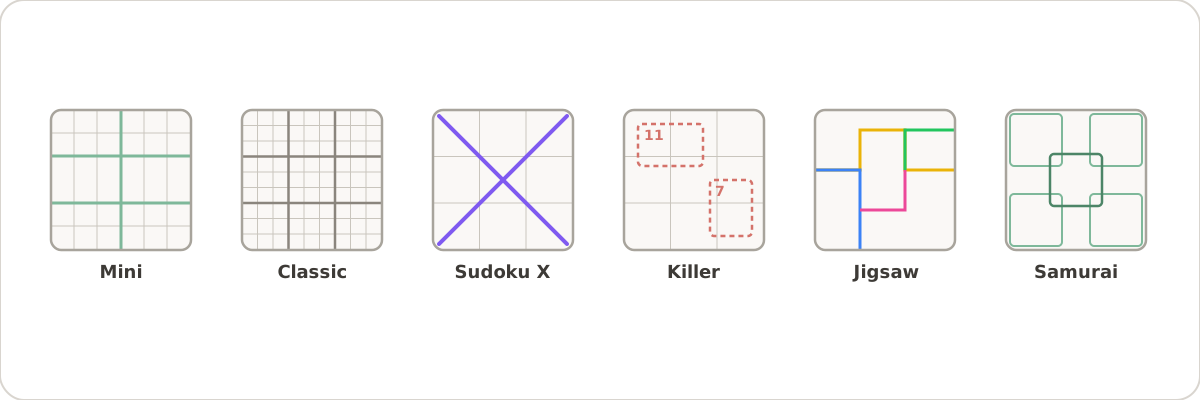
Mini vs Classic vs Killer vs Jigsaw vs Samurai Sudoku: Which Should You Play?
A side-by-side comparison of every Sudoku variant we offer, so you can pick the right one for your mood and skill level.
Read more
The Benefits of Playing Sudoku Every Day
What a daily puzzle habit actually does for your focus, memory, and stress levels.
Read more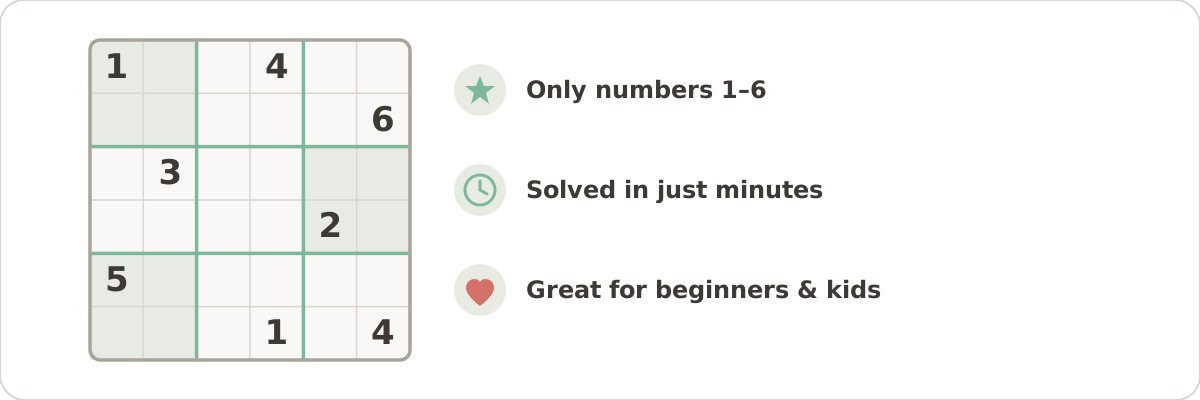
Why Mini Sudoku (6x6) Is the Perfect Starting Point
Why the smaller grid is the easiest way into Sudoku for beginners and kids alike.
Read more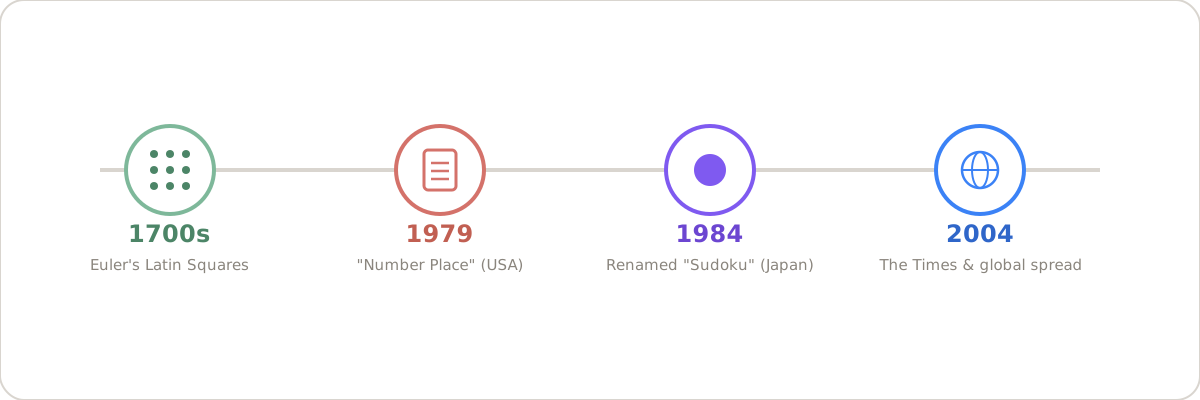
The History of Sudoku: From Newspaper Puzzle to Daily Habit
How a 1970s number-placement puzzle became a worldwide daily ritual.
Read more