
Classic Sudoku Rules: How to Play 9x9 Sudoku Step by Step
Classic Sudoku is the 9x9 puzzle most people picture when they hear the word "Sudoku" — the format that spread through newspapers worldwide and became a daily habit for millions. The rules haven't changed since: three simple constraints, applied to 81 cells, with logic alone getting you to a single correct solution. This guide covers the full rule set, walks through a real worked example, and answers the questions that come up most for new players.
The grid
A Classic Sudoku board is 9 cells wide and 9 cells tall — 81 cells in total. Those 81 cells are split into nine 3x3 boxes, each outlined with a bolder border so it's easy to tell apart from the thinner row and column lines. Every puzzle starts with a set of cells already filled in as clues; the rest is left for you to deduce.
The three rules
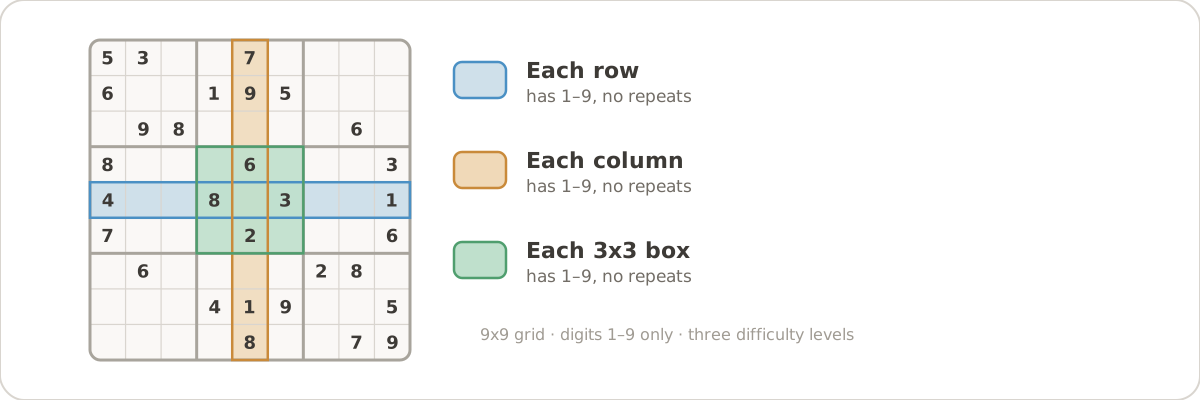
Every rule in Sudoku comes down to one statement, applied to three overlapping groups of cells. Fill the grid with the digits 1 through 9 so that:
- • Each row (left to right) contains 1–9 exactly once — no repeats.
- • Each column (top to bottom) contains 1–9 exactly once — no repeats.
- • Each 3x3 box contains 1–9 exactly once — no repeats.
All three rules hold at the same time, everywhere on the board. A digit repeating in its box is just as much a violation as one repeating in its row, even if the two cells are nowhere near each other visually. A well-formed puzzle has exactly one arrangement of digits that satisfies all three rules simultaneously — solving it is the process of finding that one arrangement through elimination, never guessing.
What Classic Sudoku is not
Despite being built from numbers, standard Sudoku involves no arithmetic at all. You never add, subtract, or weigh one digit against another — 1 through 9 are simply nine distinct symbols that each need to appear once per row, column, and box. That's a genuinely different puzzle from Killer Sudoku, which layers sum constraints on top of these same three rules, or Sudoku X, which adds two more lines (the diagonals) that also need to hold 1–9 once each.
A worked example
Look at the highlighted row, column, and box in the image above. The highlighted row already contains 4, 8, 3, and 1, leaving five digits — 2, 5, 6, 7, 9 — unplaced somewhere in its remaining five cells. The highlighted column is further along: it already has 7, 9, 6, 2, 1, and 8 filled in, leaving just three digits — 3, 4, 5 — unplaced across its three empty cells. The highlighted box already has 6, 8, 3, and 2 filled in, leaving 1, 4, 5, 7, 9 unplaced across its five empty cells.
That's the core technique for most of a puzzle: pick a row, column, or box that's mostly full, list what's missing, then cross-check each candidate digit against the other two groups that empty cell belongs to. Once only one digit survives all three checks for a given cell, place it and move to the next mostly-full line. Harder puzzles simply start with fewer mostly-full lines, which is exactly what the clue counts below control.
Once single-candidate cells run out, you'll need techniques like hidden singles and naked pairs to keep going — our solving techniques guide covers the full progression from beginner scanning to advanced patterns like the X-Wing.
Notes (pencil marks)
When a cell has more than one digit still possible, toggle notes mode and tap each candidate into the cell as a small reminder rather than trying to track every possibility from memory. Notes don't have to obey the row/column/box rule themselves — they're scratch space, and you can add or erase them freely as you narrow things down. Only the final digit you actually commit to a cell needs to satisfy the puzzle's rules. Most Easy puzzles are solvable without ever opening notes; they become genuinely useful once you reach Medium and essential by Hard, where mostly-full lines are scarce early on.
Difficulty levels
Difficulty is set by how many of the 81 cells are given to you as starting clues:
Easy
41 of 81 clues
Good for warming up
Medium
31 of 81 clues
A solid, balanced challenge
Hard
23 of 81 clues
For experienced solvers
For reference, a proper Sudoku puzzle — one with exactly one valid solution — needs a mathematical minimum of 17 clues; puzzles with fewer than that can't guarantee a unique answer. Every difficulty here stays well above that floor.
Common rule mix-ups
- • "Different row and column means it's fine" — not if the digit repeats within the same 3x3 box. All three rules apply independently and simultaneously, not one at a time.
- • Confusing notes with committed answers — a pencil-marked candidate isn't a placed digit, and won't be flagged as a conflict the way a filled cell will.
- • Assuming boxes align with rows or columns — a 3x3 box spans three different rows and three different columns at once; it's a distinct third grouping, not a shortcut for either.
- • Treating digits as quantities — there's no addition, subtraction, or "bigger than" comparison anywhere in standard Sudoku; the digits are just nine distinct labels.
Ready to put the rules into practice? Start with Easy and work your way up.
Play Classic SudokuFrequently asked questions
What are the basic rules of Classic Sudoku?
Fill a 9x9 grid so that every row, every column, and every 3x3 box contains the digits 1 through 9 exactly once, with no repeats anywhere within any of those three groups.
How many clues does a Classic Sudoku puzzle start with?
It depends on difficulty: Easy puzzles start with 41 of the 81 cells filled in, Medium with 31, and Hard with just 23 — the fewer the starting clues, the more deduction is required.
Does Classic Sudoku involve math?
No. Sudoku is a placement and logic puzzle, not an arithmetic one. The digits 1-9 are nine distinct labels, not values to add or compare — you never perform a calculation to solve a standard Sudoku grid.
What's the minimum number of clues a Sudoku puzzle can have?
Mathematically, a proper Sudoku puzzle (one with a single unique solution) needs at least 17 clues. Puzzles with fewer than 17 filled cells cannot have a unique solution, which is why even our Hard difficulty stays comfortably above that floor.
Is Classic Sudoku the same puzzle as the one in newspapers?
Yes. The 9x9, digits 1-9, three-rule format is the standard Sudoku popularized by newspapers worldwide since the mid-2000s. Variants like Killer, Jigsaw, or Sudoku X add extra constraints on top of these same base rules.
Can two different digits go in the same box as long as they're in different rows?
Two different digits can certainly share a box — that's normal, since a box holds nine cells. What's not allowed is the same digit appearing twice in that box, regardless of which rows or columns those two cells sit in.
Keep reading
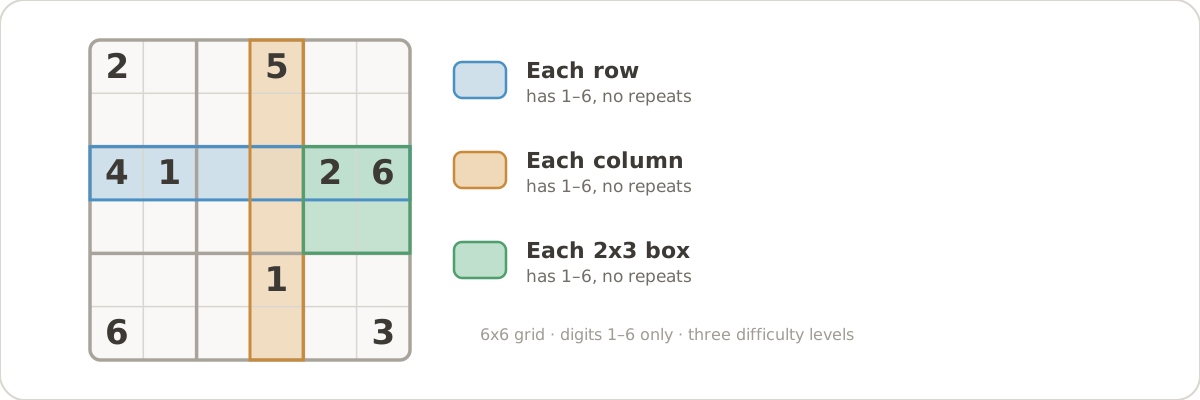
Mini Sudoku Rules: The Complete 6x6 Beginner's Guide
Every rule of 6x6 Mini Sudoku explained with board diagrams and a worked example.
Read more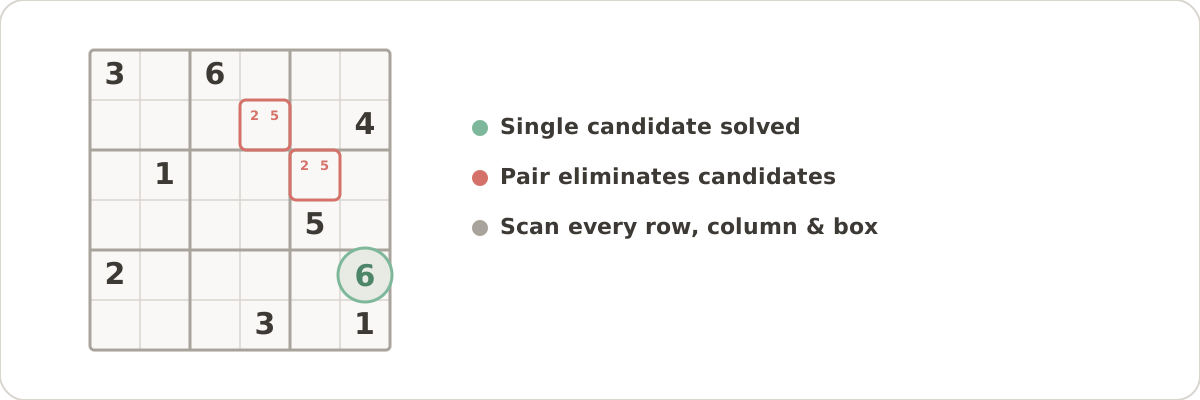
Sudoku Solving Techniques: A Complete Guide From Beginner to Advanced
The techniques that actually solve puzzles, from basic scanning to the X-Wing.
Read more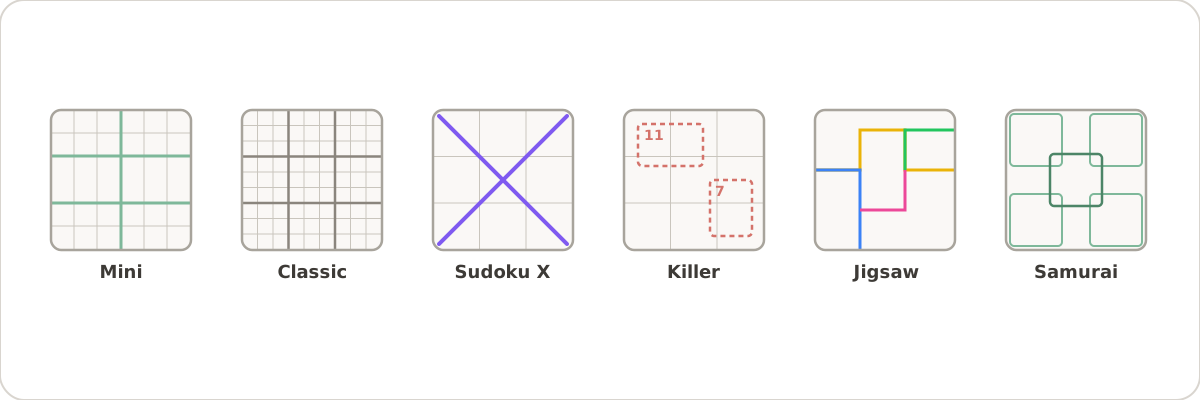
Mini vs Classic vs Killer vs Jigsaw vs Samurai Sudoku: Which Should You Play?
A side-by-side comparison of every Sudoku variant we offer.
Read more