
Killer Sudoku Rules Explained: How Cages and Sums Work
Killer Sudoku takes the standard 9x9 rule set and layers a second puzzle on top of it: dashed "cages" of cells that must add up to a printed target sum. It's the one variant on this site that genuinely does involve arithmetic, and that combination of sums plus placement logic is exactly what makes it feel different from every other Sudoku variant. This guide covers the full rule set, walks through cage arithmetic with real examples, and answers the questions solvers ask most.
The grid
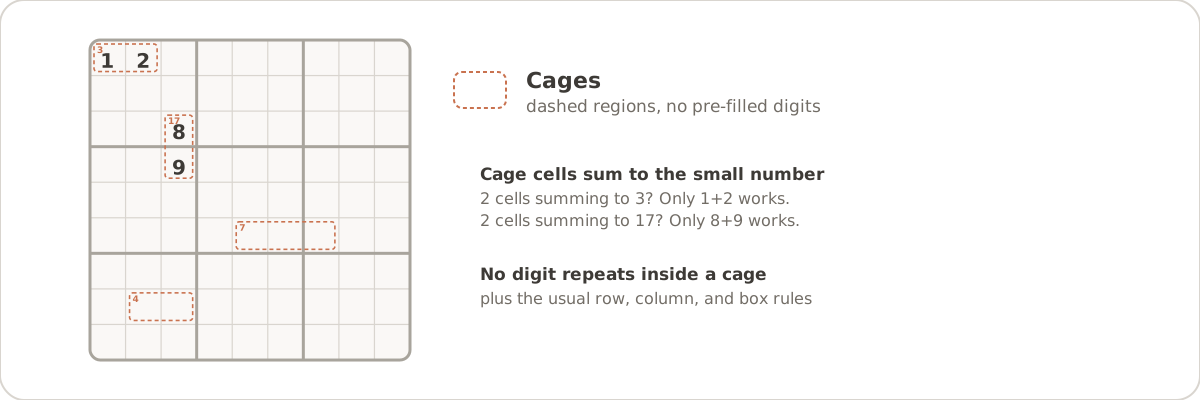
Killer Sudoku uses the same 9x9 grid as Classic Sudoku — 81 cells in nine 3x3 boxes. On top of that grid, the puzzle overlays a set of cages: groups of neighboring cells outlined with a dashed border, each labeled with a small number in its top-left corner. That number is the sum every digit inside the cage must add up to.
The rules: standard, plus cages
Every Classic Sudoku rule still applies in full:
- • Each row contains 1–9 exactly once — no repeats.
- • Each column contains 1–9 exactly once — no repeats.
- • Each 3x3 box contains 1–9 exactly once — no repeats.
Killer Sudoku adds two more requirements on top of those three:
- • Every cage's digits must add up to its target sum — exactly, no more and no less.
- • No digit repeats inside a cage, even if the row, column, and box rules alone would allow it.
Cages can be almost any connected shape — a straight line, an L, a zigzag — and they often cross box and row boundaries freely. Most hold between two and five cells. What never changes is the arithmetic: sum up right, no repeats, every time.
A worked example: reading cage sums
Look at the two solved cages in the image above. The top-left cage holds 2 cells and sums to 3. Since digits can't repeat and every digit is between 1 and 9, the only pair of distinct digits that adds up to 3 is 1 and 2 — there's no other option, so both cells are solved the moment you read the cage label, before checking a single row or column.
The second cage holds 2 cells and sums to 17. At the opposite extreme, the only pair that reaches 17 without repeating a digit is 8 and 9. Sums near the low end (like 3) or the high end (like 17) of a 2-cell cage's possible range (3 through 17) tend to have exactly one valid combination, which makes them the fastest cages to solve on sight.
The two unlabeled cages further down — a 3-cell cage summing to 7, and a 2-cell cage summing to 4 — work the same way, just with a bit more to narrow down: a 3-cell cage summing to 7 can only be some arrangement of 1, 2, and 4, while a 2-cell cage summing to 4 can only be 1 and 3 (never 2 and 2, since digits can't repeat). Once you've listed a cage's possible digit sets, cross-check them against the row, column, and box rules the same way you would in Classic Sudoku to figure out which cell gets which digit.
Fast combinations worth memorizing
A handful of cage sums have only one possible digit combination, which makes them worth recognizing on sight:
- • 2-cell cage summing to 3 — must be 1 + 2.
- • 2-cell cage summing to 4 — must be 1 + 3.
- • 2-cell cage summing to 16 — must be 7 + 9.
- • 2-cell cage summing to 17 — must be 8 + 9.
- • 3-cell cage summing to 6 — must be 1 + 2 + 3.
- • 3-cell cage summing to 24 — must be 7 + 8 + 9.
Cages in the middle of the possible range (a 2-cell cage summing to 9 or 10, for example) usually have several valid combinations, which is where you'll lean more heavily on the row, column, and box rules to narrow things down. For the broader technique library those rules draw on, see our solving techniques guide.
Notes (pencil marks)
Because Killer Sudoku often gives you few or no pre-filled digits, notes matter more here than in most variants. A common approach is to jot every possible digit combination for a cage as candidates, then eliminate combinations as you cross-check them against the row, column, and box a cell belongs to. As with every variant, notes are just scratch space — only the digit you finally commit to a cell needs to satisfy every rule at once.
Difficulty levels
Unlike other variants, Killer Sudoku difficulty is driven mostly by how many pre-filled givens accompany the cages, not just the cage layout itself:
Easy
~20 givens + cages
Approachable for beginners
Medium
~10 givens + cages
More cage arithmetic required
Hard
Cages only, no givens
Advanced logic and combinations
Common rule mix-ups
- • Assuming a digit can repeat in a cage if the sum still works — it can't; 2+2=4 is arithmetically valid but illegal in a 2-cell cage because the digits repeat.
- • Expecting cages to respect box boundaries — they don't. A single cage can span two or three different 3x3 boxes.
- • Forgetting the standard rules still apply — solving a cage's arithmetic doesn't override the row, column, and box rules; a digit still needs to satisfy all of them at once.
- • Treating every cage sum as ambiguous — sums at the extreme ends of a cage's possible range (very low or very high for its cell count) often have exactly one valid combination, worth spotting immediately.
Ready to try cage arithmetic for yourself? Start with Easy to get a feel for reading cage sums.
Play Killer SudokuFrequently asked questions
What are the rules of Killer Sudoku?
Killer Sudoku combines standard Sudoku with cage sums: fill a 9x9 grid so every row, column, and 3x3 box contains 1-9, while every dashed-outline cage also adds up to its printed target sum with no digit repeated inside that cage.
Can digits repeat inside a Killer Sudoku cage?
No. Every digit inside a cage must be unique, on top of adding up to the target sum. A two-cell cage can never contain the same digit twice, even if the sum would technically allow it (like 2+2=4).
Are there pre-filled numbers in Killer Sudoku like regular Sudoku?
Sometimes, but not always. Easy Killer Sudoku puzzles include a handful of pre-filled givens alongside the cages, Medium includes fewer, and Hard typically relies on cages alone with no pre-filled digits at all, so every digit is derived purely from cage arithmetic and Sudoku logic.
How do you solve a 2-cell cage in Killer Sudoku?
Check whether the target sum has only one possible pair of distinct digits. A 2-cell cage summing to 3 can only be 1+2, and a 2-cell cage summing to 17 can only be 8+9 — sums at the extreme low or high end of the 1-9 range usually have just one valid combination.
Do Killer Sudoku cages have to be square or rectangular?
No. Cages can be any connected shape — a straight line of cells, an L-shape, a zigzag — as long as every cell in the cage touches at least one other cell in that same cage edge to edge. Most cages hold between two and five cells.
Can a cage span more than one 3x3 box?
Yes. Cages are drawn independently of the box boundaries and frequently cross from one 3x3 box into a neighboring one. A cage's only structural rule is that it can't contain the same digit twice, regardless of which rows, columns, or boxes its cells fall into.
Keep reading
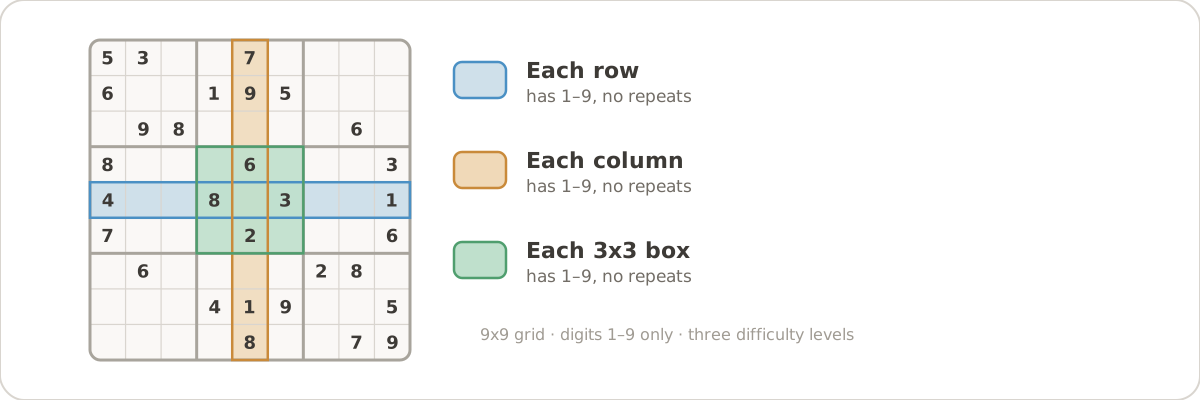
Classic Sudoku Rules: How to Play 9x9 Sudoku Step by Step
The base rules Killer Sudoku builds on, with a worked example and difficulty levels.
Read more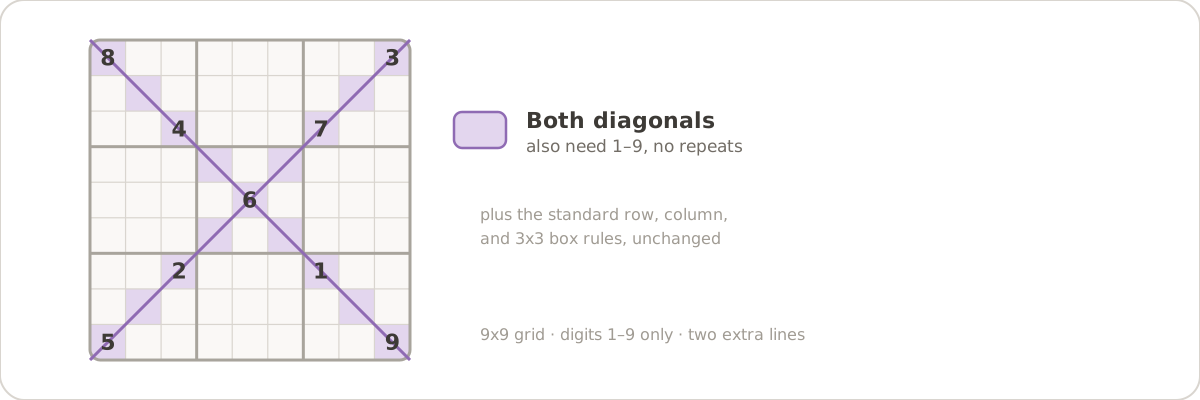
Sudoku X Rules: How Diagonal Sudoku Changes the Game
Another twist on the standard rules — two extra diagonal lines instead of cages.
Read more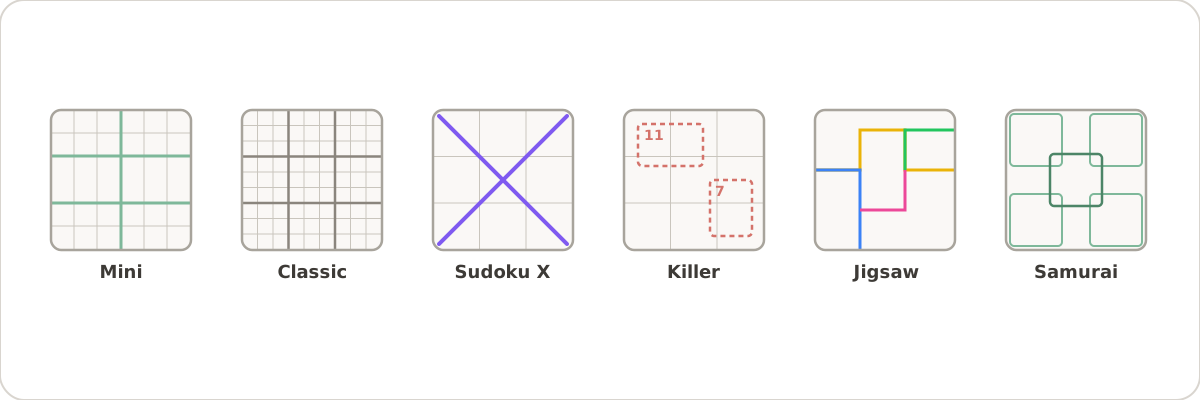
Mini vs Classic vs Killer vs Jigsaw vs Samurai Sudoku: Which Should You Play?
A side-by-side comparison of every Sudoku variant we offer.
Read more