
Jigsaw Sudoku takes Classic Sudoku's grid and rows and columns, then swaps the tidy 3x3 boxes for nine irregular, puzzle-piece-shaped regions. It looks dramatically different at a glance, but the underlying logic barely changes — you're still hunting for the one digit that fits, just with a lumpier third group to track. This guide covers the full rule set, walks through a worked example, and answers the questions that come up most when solvers try it for the first time.
The grid
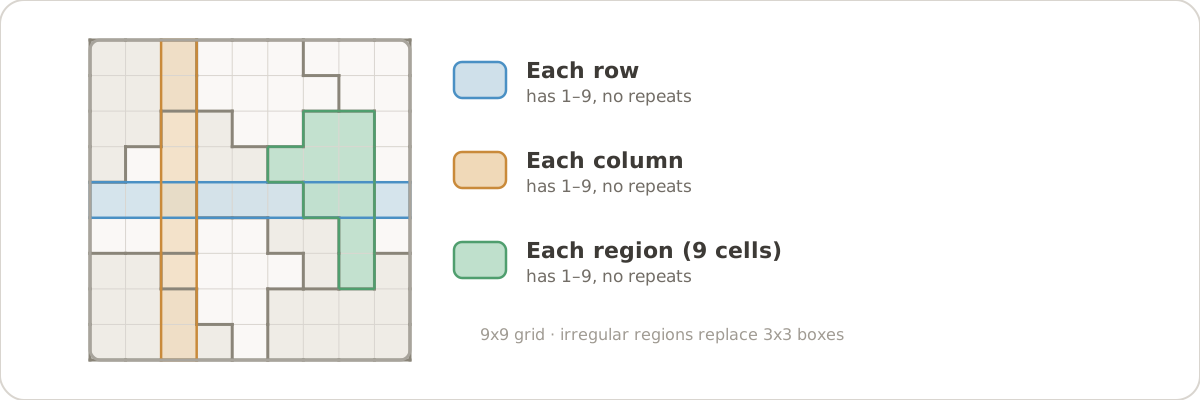
Jigsaw Sudoku uses the same 9x9 grid as Classic Sudoku — 81 cells, same rows, same columns. What's different is the third grouping: instead of nine uniform 3x3 boxes, the grid is divided into nine irregular regions, each covering exactly 9 cells. Every region is shaded a different tint and outlined with a thick border so it's easy to trace its shape at a glance, even though no two regions look alike.
The rules: same three groups, one reshaped
Fill the grid with the digits 1 through 9 so that:
- • Each row contains 1–9 exactly once — no repeats.
- • Each column contains 1–9 exactly once — no repeats.
- • Each irregular region (9 connected cells) contains 1–9 exactly once — no repeats.
That's the entire rule set — genuinely identical in structure to Classic Sudoku, with the box rule simply reapplied to a different-shaped group of 9 cells. A region has to be a single connected shape (every cell touching at least one other cell in the same region edge to edge), and it very often stretches across what would have been two or three separate 3x3 boxes in the standard layout.
A worked example
Look at the highlighted region in the image above. It's a zigzagging shape that dips through parts of four different rows and three different columns — nothing like a tidy square — but it still holds exactly 9 cells, and every one of those cells still needs to end up with a different digit from 1 to 9, no repeats. The highlighted row and column work exactly as they would in Classic Sudoku: count what's already placed, and whatever's left has to go somewhere in the remaining empty cells.
The only real adjustment for solving is visual: before you can apply region logic to a cell, you have to trace its region's actual boundary rather than assuming a 3x3 square. Once you've done that, every technique from scanning to naked pairs carries over unchanged — see our solving techniques guide for the full method list.
Why irregular regions change the feel
Removing the fixed 3x3 boxes removes a mental shortcut most Sudoku players rely on without noticing: knowing exactly which nine cells a box covers without having to look. In Jigsaw Sudoku, a region can be tall and thin, an L-shape, or a scattered zigzag, so you have to actually trace its outline before you can reason about it — which slows down scanning at first but tends to reveal deductions a rigid box shape would hide. A region that pokes deep into an otherwise sparse row, for instance, can sometimes pin down a digit long before the row itself is anywhere close to full.
Notes (pencil marks)
Notes work exactly as they do in Classic Sudoku: toggle notes mode and tap a candidate into a cell as a reminder rather than a commitment. The one habit worth building specifically for Jigsaw Sudoku is double-checking a cell's region before ruling out a candidate — it's easy to mentally default to "3x3 box" out of habit and eliminate a digit for the wrong group of cells.
Difficulty levels
Difficulty is set by how many of the 81 cells are given as starting clues — the same clue counts as Classic Sudoku, since the row and column rules carry most of the same weight regardless of region shape:
Easy
41 of 81 clues
Good for getting used to irregular regions
Medium
31 of 81 clues
A solid challenge
Hard
23 of 81 clues
For experienced solvers
Common rule mix-ups
- • Assuming a region looks like a 3x3 box — it almost never does. Always trace the actual colored/outlined shape before applying region logic to a cell.
- • Expecting regions to line up with box rows — a single region can, and usually does, span cells from what would be two or three separate 3x3 boxes in Classic Sudoku.
- • Thinking diagonal touches count — a region is only connected through shared edges. Two cells that only touch at a corner are not automatically part of the same region.
- • Forgetting rows and columns are unchanged — the region shape is the only thing that's different; row and column logic works exactly like Classic Sudoku.
Ready to trace some irregular regions yourself? Start with Easy to get comfortable with the shapes.
Play Jigsaw SudokuFrequently asked questions
What are the rules of Jigsaw Sudoku?
Jigsaw Sudoku uses a 9x9 grid where every row and every column must contain the digits 1 through 9 exactly once, just like Classic Sudoku. The only difference is that the nine 3x3 boxes are replaced with nine irregular-shaped regions of 9 cells each, and every region must also contain 1-9 exactly once.
Is Jigsaw Sudoku the same as Irregular Sudoku or Nonomino Sudoku?
Yes, those are all names for the same variant. "Nonomino" refers to a nine-celled irregular shape, similar to how a domino has two cells and a pentomino has five — each Jigsaw Sudoku region is a nonomino.
Do the irregular regions change from puzzle to puzzle?
Yes. Unlike Classic Sudoku's fixed 3x3 boxes, every Jigsaw Sudoku puzzle has its own unique set of nine region shapes, generated fresh each time. You can't memorize a region layout the way you can with standard boxes.
Can a Jigsaw Sudoku region be any shape?
It has to be a single connected group of exactly 9 cells, where every cell touches at least one other cell in the same region edge to edge (not just at a corner). Beyond that, the shape can be as irregular as it likes — an L, a zigzag, a plus sign, anything connected.
How many clues does a Jigsaw Sudoku puzzle start with?
Easy starts with 41 of the 81 cells filled in, Medium with 31, and Hard with 23 — the same clue counts as Classic Sudoku, since the row and column rules do most of the same work regardless of region shape.
Can a region span more than one row of 3x3 boxes?
Yes, and it usually does. Jigsaw regions are drawn without any regard for where the old 3x3 boxes would have been, so a single region routinely stretches across what would be two or three different boxes in Classic Sudoku.
Keep reading
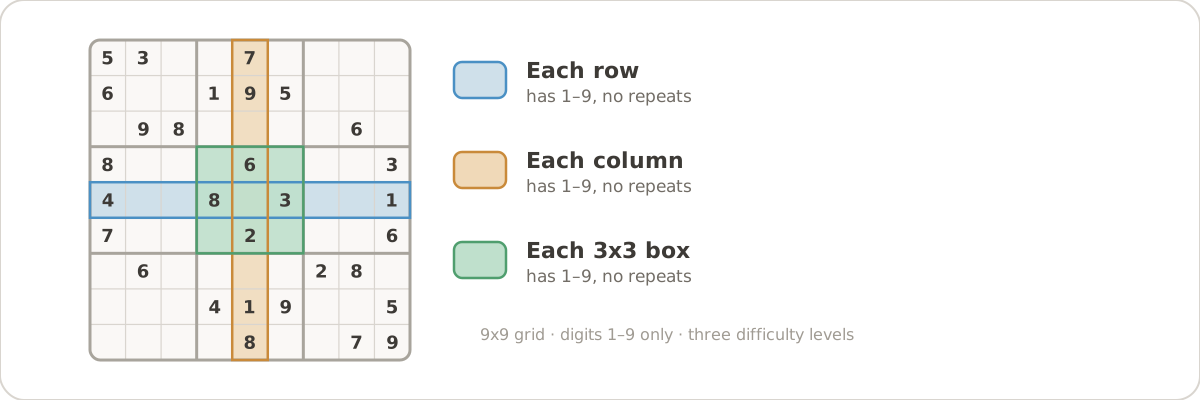
Classic Sudoku Rules: How to Play 9x9 Sudoku Step by Step
The base rules Jigsaw Sudoku builds on, with a worked example and difficulty levels.
Read more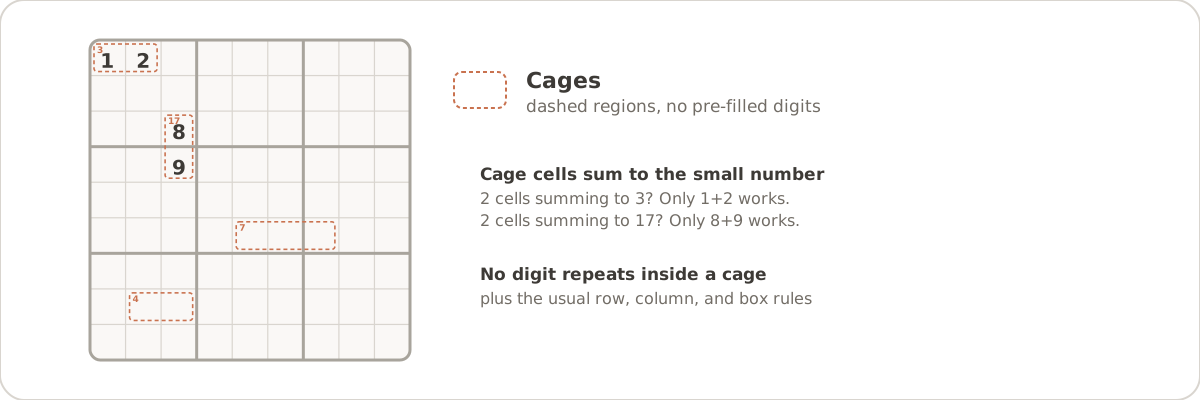
Killer Sudoku Rules Explained: How Cages and Sums Work
Another twist on the standard rules — cage arithmetic instead of irregular regions.
Read more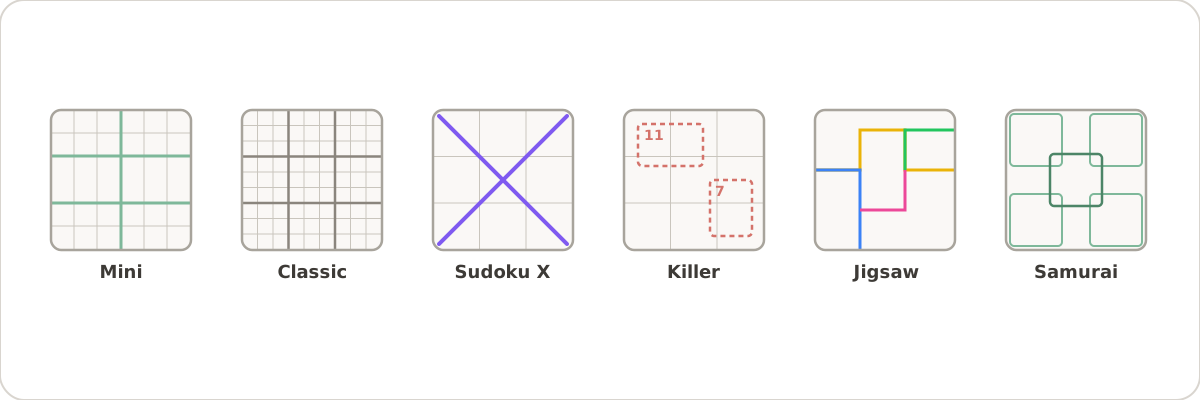
Mini vs Classic vs Killer vs Jigsaw vs Samurai Sudoku: Which Should You Play?
A side-by-side comparison of every Sudoku variant we offer.
Read more