A lot of people pick up Sudoku for the same reason they pick up any puzzle: it's fun, and a finished grid feels good. But there's a reason so many people turn a single puzzle into a daily habit — the benefits compound in ways that are easy to underestimate.
It's focused, low-stakes concentration practice
Sudoku demands your full attention but nothing else — no timer pressure unless you set one, no opponent, no consequence for pausing. That combination makes it an unusually good way to practice sustained focus. Working through candidates cell by cell is a small, repeatable exercise in holding a train of thought without getting distracted, which is a skill that transfers well beyond the puzzle itself.
It exercises working memory
Solving a grid without pencil marks means holding several candidate numbers in your head at once while you check them against three overlapping constraints (row, column, box). That's a genuine working-memory workout — the same mental muscle you use to follow multi-step instructions or do arithmetic without a calculator. Playing regularly is one of the simplest ways to keep that muscle active.
It builds pattern recognition over time
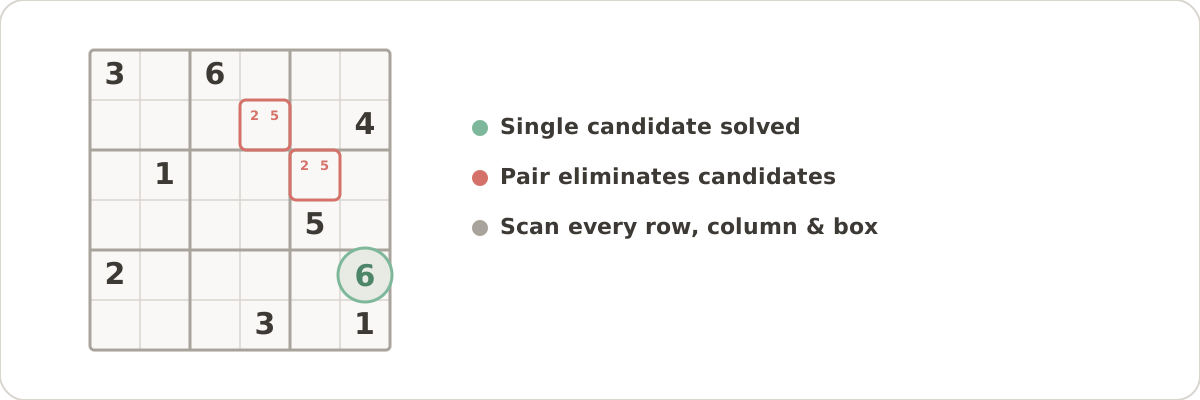
The first time you spot a hidden single or a naked pair, it takes real effort. After a few weeks of daily puzzles, your eye starts catching those patterns almost automatically. That shift — from effortful calculation to fast recognition — is the same kind of learning curve you see in chess or music, just compressed into a five-minute daily puzzle instead of years of practice. Our solving techniques guide covers the specific patterns worth training your eye on.
It's a genuine break from screens that scroll
Unlike a feed that's designed to keep scrolling indefinitely, a Sudoku puzzle has a clear beginning and end. You sit down, you solve it (or don't), and you're done — there's a natural stopping point built into the activity. That structure is part of why so many people use it as a wind-down ritual: it occupies the mind fully enough to crowd out rumination, without the open-ended pull of social media or video.
It scales with your schedule
A 6x6 Mini Sudoku on Easy takes a couple of minutes; a Hard 9x9 can take twenty or more. That range means a daily habit doesn't require a big time commitment — you can fit one in during a coffee break and still get the same focus and memory benefits as a longer session. That's the whole idea behind our daily puzzle: a fresh, bite-sized challenge every day, with Unlimited mode available whenever you want more.
Worth noting: Sudoku is a fun, engaging mental exercise, but it isn't a substitute for medical or cognitive-health advice. Think of it the way you'd think of a daily walk — a small, consistent habit that's good for you, not a cure for anything.