
The History of Sudoku: From Newspaper Puzzle to Daily Habit
Sudoku feels distinctly Japanese — the name is Japanese, and it exploded in popularity there before anywhere else. But the puzzle itself was invented in the United States, built on a mathematical idea that's over two centuries old, and it took a retired judge with a laptop to turn it into a global habit. Here's the full chain of events, plus a few of the numbers behind the puzzle that don't usually make it into the short version of this story.
It starts with Euler's Latin squares
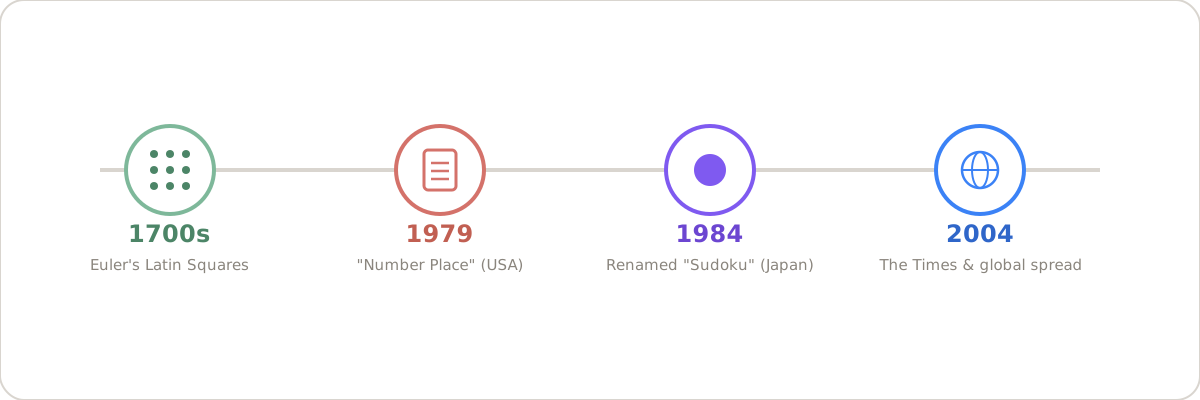
In the 18th century, Swiss mathematician Leonhard Euler studied "Latin squares" — grids where each symbol appears exactly once in every row and every column. That row/column uniqueness rule is exactly half of Sudoku's logic. What Latin squares didn't have was Sudoku's other rule: the sub-grid (box) constraint that makes the puzzle solvable with pure deduction rather than needing many valid solutions.
Euler's most famous brush with this idea is his 1782 "36 officers problem": arrange 36 officers of six different ranks from six different regiments in a 6x6 grid so that no row or column repeats a rank or a regiment. He conjectured it was impossible — and he was right, though it took until 1900 for mathematician Gaston Tarry to prove it. Sudoku's own history isn't perfectly tidy either: French newspapers like Le Siècle and La France briefly published very Sudoku-like Latin-square puzzles as far back as the 1890s, though that tradition died out with no direct link to the modern game.
The modern puzzle: Indianapolis, 1979
The Sudoku format we play today — a 9x9 grid, 3x3 boxes, one unique solution — was created by Howard Garns, a retired architect and freelance puzzle constructor, and first published by Dell Magazines in 1979 under the name "Number Place." It wasn't an overnight hit; it existed as one puzzle type among many in American puzzle magazines for years, with little fanfare. Dell didn't credit individual constructors by name at the time, so the attribution to Garns comes from later research by puzzle historians rather than a byline on the original page — but he's the name virtually everyone in the puzzle world points to.
Japan gives it its name
In 1984, Japanese puzzle publisher Nikoli picked up Number Place and renamed it "Suuji wa dokushin ni kagiru" — roughly, "the numbers must remain single." That was shortened to Sudoku (a contraction of "su," number, and "doku," single) a couple of years later. Nikoli's president at the time, Maki Kaji, is often called "the father of Sudoku" for popularizing it in Japan — a title he was careful to distinguish from "inventor," since he always credited the original American puzzle.
Nikoli also refined the puzzle's design conventions, including hand-crafting each grid so the given clues are arranged in rotational symmetry — more about visual elegance than difficulty, but it became part of the puzzle's identity and still distinguishes hand-built Nikoli puzzles from purely computer-generated ones. One more quirk from this era: "Sudoku" is a registered trademark of Nikoli within Japan, which is why Japanese competitors still market their own versions of the puzzle under different names.
The 2004 explosion
Sudoku stayed a mostly Japanese phenomenon for two decades until Wayne Gould, a retired Hong Kong judge, came across it in a Tokyo bookshop in 1997 and spent years writing a computer program to generate puzzles quickly and reliably. He pitched it to The Times of London, which began publishing a daily Sudoku in November 2004. Other UK and US newspapers followed almost immediately, and within two years it had its own competitive circuit — the first World Sudoku Championship was held in Lucca, Italy in March 2006 — plus dedicated puzzle books and eventually apps and websites like this one.
Why it never really faded
Most puzzle crazes fade once the novelty wears off. Sudoku's staying power comes down to a rare combination: the rules take thirty seconds to learn, no language or vocabulary is required, difficulty scales smoothly from beginner to expert, and — unlike crosswords — every generated puzzle is genuinely new. That same portability is why the format has spawned so many variants over the years: Killer Sudoku added arithmetic in the 1990s under the Japanese name "Samunanpure" (a contraction of "sum number place") before Western newspapers picked it up in the mid-2000s, Jigsaw Sudoku reshaped the boxes into irregular regions, and smaller formats like our own 6x6 Mini Sudoku exist simply because the core logic works at any size. See our variant comparison guide for how they all differ today, or our solving techniques guide for the logic that hasn't changed since Garns' original grid.
Sudoku by the numbers
- • 6,670,903,752,021,072,936,960 — the total number of valid completed 9x9 grids, computed by Bertram Felgenhauer and Frazer Jarvis in 2005.
- • 17 — the proven minimum number of starting clues a 9x9 puzzle can have and still have a unique solution, confirmed by an exhaustive 2012 computer search.
- • 1979 — the year the modern 9x9 format first appeared, as "Number Place" in Dell Magazines.
- • 1984 — the year Nikoli published it in Japan and began renaming it toward "Sudoku."
- • 2004 — the year The Times of London ran its first daily Sudoku, the spark that made it a global habit.
Frequently asked questions
Who actually invented Sudoku?
The modern 9x9 puzzle is credited to Howard Garns, a retired American architect and freelance puzzle constructor, who published it as "Number Place" with Dell Magazines in 1979. Exact attribution is debated since Dell didn't credit individual constructors by name at the time, but Garns is the name most puzzle historians point to.
Is Sudoku actually Japanese?
The puzzle itself was invented in the United States in 1979. It only became "Sudoku" after the Japanese publisher Nikoli imported it in 1984, renamed it, and refined its design conventions. Japan is where it got its name and its first devoted following, not where it was invented.
What does the word "Sudoku" mean?
Sudoku is a contraction of the Japanese phrase "suuji wa dokushin ni kagiru," roughly "the numbers must remain single" — a reference to the rule that no digit can repeat in a row, column, or box. "Su" means number and "doku" means single or unmarried.
What's the minimum number of clues a Sudoku puzzle can have?
17 givens. A 2012 exhaustive computer search by researchers McGuire, Tugemann, and Civario proved that no 9x9 puzzle with only 16 starting clues can have a unique solution, making 17 the proven minimum.
How many possible Sudoku solutions are there?
There are exactly 6,670,903,752,021,072,936,960 valid completed 9x9 grids — a figure computed by Bertram Felgenhauer and Frazer Jarvis in 2005. That's before accounting for symmetries like rotation and relabeling, which reduce the count of essentially distinct grids much further.
When did Sudoku become popular outside Japan?
In 2004, when Wayne Gould, a retired Hong Kong judge who had discovered the puzzle in a Tokyo bookshop, persuaded The Times of London to run a daily Sudoku. Other UK and US newspapers followed within months, and by 2006 it had its own World Sudoku Championship.
Keep reading
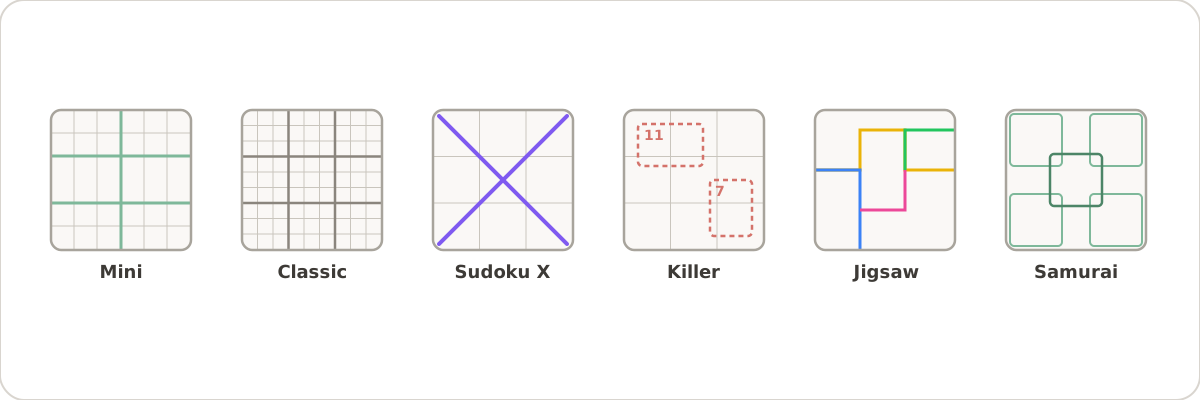
Mini vs Classic vs Killer vs Jigsaw vs Samurai Sudoku: Which Should You Play?
A side-by-side comparison of every Sudoku variant we offer.
Read more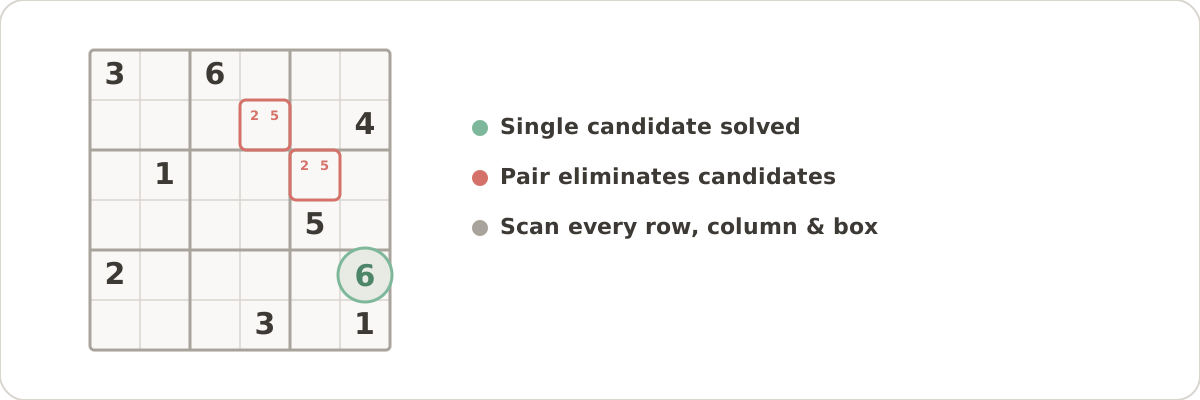
Sudoku Solving Techniques: A Complete Guide From Beginner to Advanced
The techniques that actually solve puzzles, from basic scanning to the X-Wing and beyond.
Read more
The Benefits of Playing Sudoku Every Day
What a daily puzzle habit actually does for your focus, memory, and stress levels.
Read more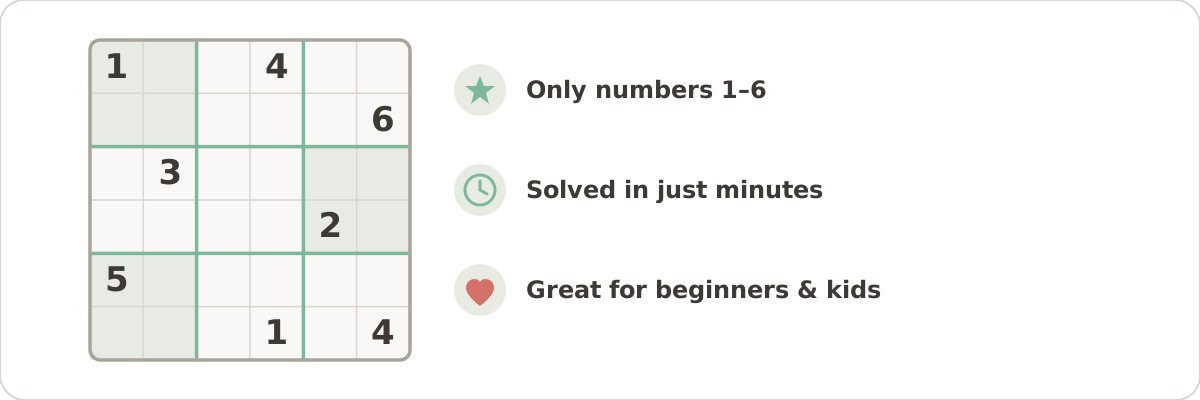
Why Mini Sudoku (6x6) Is the Perfect Starting Point
Why the smaller grid is the easiest way into Sudoku for beginners and kids alike.
Read more